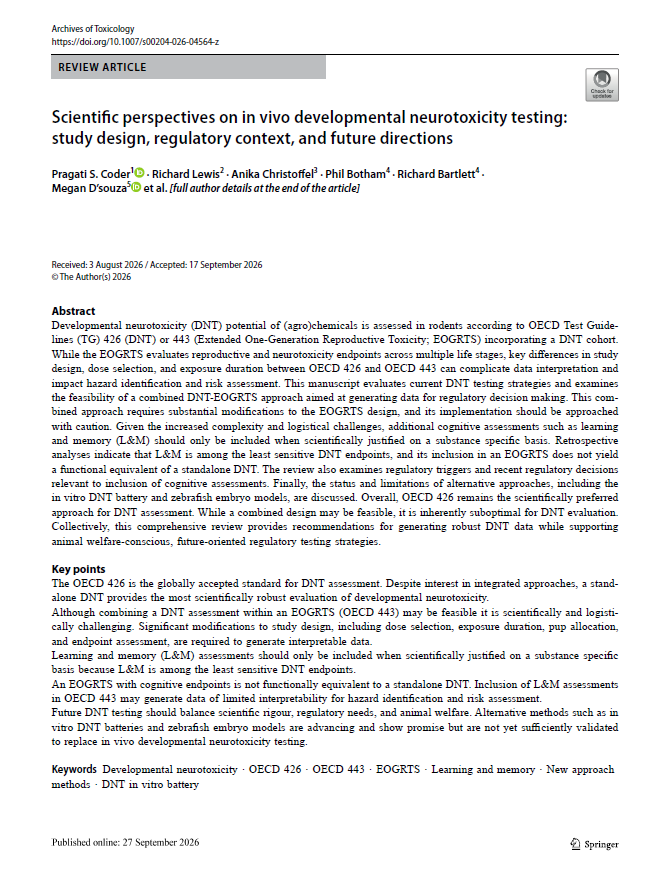
Brussels, 1 October 2026 – ECETOC is pleased to announce the publication of a new review article in Archives of Toxicology titled “Scientific Perspectives on In Vivo Developmental Neurotoxicity T...
We are pleased to welcome Talia Neal-Walthall to ECETOC as a secondee. Talia joins us to work on topics related to exposure, an area central to much of our current scientific programme. She will be wi...
This software was developed by a consortium of partners to facilitate the uptake of novel approaches to estimate aquatic threshold concentrations (e.g. the concentration at which 5% of the species are exposed above their EC50, HC5).
Why?
The Worker TRA Task Force has been active since 2019, delivering projects that advance the scientific basis of the Worker Targeted Risk Assessment (TRA) tool. Its overarching objective is to e...
Why?Regulatory assessment of immunotoxic properties of chemicals is a complex and challenging task
Limited regulatory guidance exists
Lack of industry and regulatory knowledge...
Why?Hazard and safety assessments for the pelagic compartment often rely on in vivo studies using a single fish species, raising ethical concerns and uncertainty in terms of extrapolation....
a
NGRA and NAMsThreshold of Toxicological Concern (TTC)
This report discusses the need for a systematic representation of knowledge about developmental toxicity (i.e. an ontology) that would enable computer-based prediction of which chemicals are likely to...
Chemical activity has recently been promoted as a useful concept for interpreting and classifying ecotoxicological data and for performing environmental risk assessment of chemicals. The most common...
ECETOC concept allows assessing the safety of nanomaterials undertaking animal testing only as a very last resortBrussels, December 2015The safety of nanomaterials can be ensured by testing...
Why?
The current paradigm for identifying data (study) requirements is based upon a surrogate of exposure, namely production volume, which may under or overestimate real exposure. As presented in ...
Why?
“Smart” or extended studies can be defined as in vivo studies that employ additional or different endpoints from conventional studies.They fall into 2 categories:those that follo...
Background
Recent opinions published by the RAC on low top dose selection in animal toxicity studies have indicated an apparent intent of increasing dosages systematically in view of the criteria u...








![Immunotoxicity assessment: Addressing Challenges and Advancing Methodologies [Workshop → Task Force]](https://www.ecetoc.org/wp-content/uploads/2026/07/Picture2-1024x923.jpg)